
Yangon
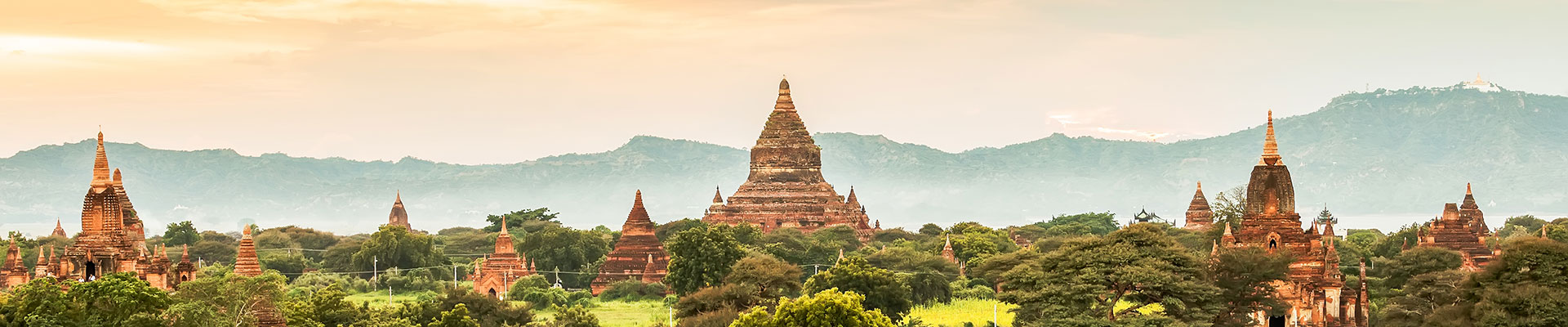
Yangon also known as “Rangoon” is a former capital of Myanmar and the commercial capital of Myanmar and the business capital of Myanmar, the main gateway to Myanmar, full of ever green and topical trees, shady parks, beautiful lakes. Yangon covers the land area of 350 sq-km with around about 6 million population. Its surrounded by water on three sides. The sprawling city was first fortified by King Alanpaya in 1755 that marked his conquest of Lower Myanmar by changing its name from Dagon to Yangon. The British established Yangon as their capital in 1852 after they won control of Lower Myanmar. Yangon was built by many beautiful colonial buildings, wide tree-lined streets and tranquil lanes with the colonial style. The places of interest are Sule pagoda “The heart of city”, The five-stories of National Museum display the literature, culture, history, ethnic groups, arts and crafts, etc., of the country. The original Lion Throne of the last king of Myanmar is one of the attractive and significant of the museum. Bogyoke Aung San Market also called Scott Market is the best place for you shopping in Yangon. The colorful building and the evening market are interesting in China Town area. The most famous landmark of Myanmar is The Shwedagon Pagoda dated over 2,600 years old and was built to house eight scared hairs of Buddha. The original pagoda was only 9 m high but it has been restored and rebuilt for many centuries to reach the current high. Which is visible from miles around and it is the most sacred of all Buddhist sites in the country for Buddhist people. There are other additional places such as Botataung Pagoda, this ancient monument situated nearby Yangon River and Kaba Aye Pagoda “the world peace Pagoda” was built in 1952 for the 1954-56 sixth Buddhist Synod. Mahapasana Cave, an artificial cave remarkably built for the commemoration of 2500th year of Buddhism. It is meant to resemble India’s Satta Panni Cave, where the First Buddhist Synod was held shortly after the Buddha’s death and the biggest marble Buddha Image of Kyauk Tawgyi Pagoda & the rare of white Elephants.
Yangon and Surrounding
Naypyidaw
Bago
Pyay
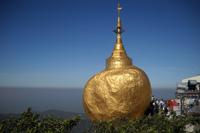
The Golden Rock
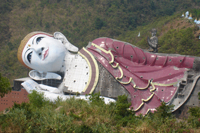
Mawlamyine
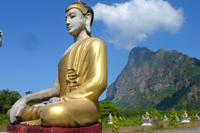
Hpa-an
Naypyidaw
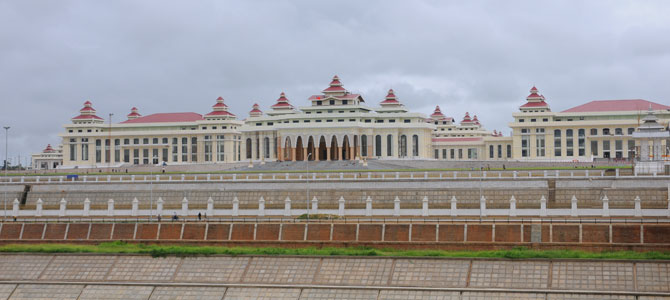
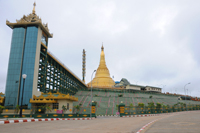
Naypyidaw, or abode of King was founded in 2006 as a Myanmar’s New capital. It is also known as an administrative capital of Myanmar. It is located 391km far from Yangon and 302 km from Mandalay. There are daily flights via Nay Pyi Taw to other tourist destinations in Myanmar. It is the center of Yangon and Mandalay. And it takes four hours driving by car from Yangon and three hours to Mandalay from Ygn-Mdy new highway road.
There are interesting places in Nay Pyi Taw :
(1) Uppatasanti Pagoda
(2) The National Land Marks Garden
(3) Zoological Garden
(4) Water Foundation Garden and
(5) The Gem Museum
(6) City Hall
(7) Myanmar International Convention Center
Bago
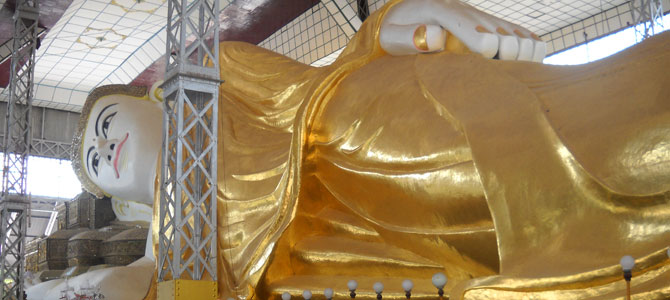
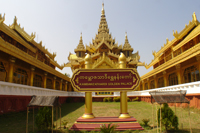
Myanmar’s culture is largely a result of heavy Indian influences intertwined with local traditions and some Chinese influences. This can be seen in the various stupas and temples throughout the country, which bear a distinct resemblance to those in northern India. Like neighbouring Thailand, Theravada Buddhism is the single largest religion, and even some of the most remote villages will have a village temple for people to pray at. Other religions which exist in smaller numbers include Christianity, Islam and Hinduism.
Pyay
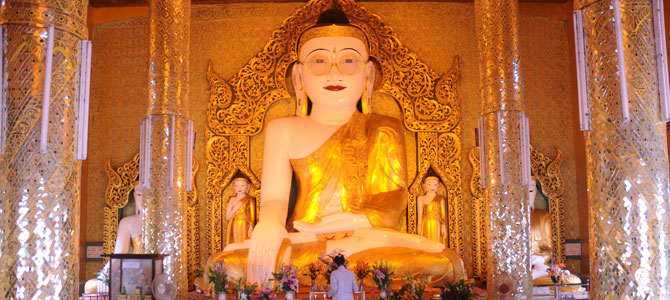
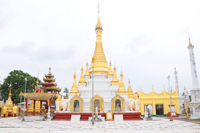
Pyay was formerly known as Prome. Pyay is only 161 km north of Yangon and on the eastern bank of the Irrawaddy River on a lovely location, traveling along a well-maintained highway by car. You can see green paddy fields along the side of the highway. Pyay was also known as Thaye-khittra (Srikshetra between 4th -9th century), the ancient Pyu capital, is interesting place to visit because of their historical importance and archaeological sites such as Patagyi Pagoda, Payama Pagoda, Bawbawgyi Pagoda & Bebe Pagoda, and the ruins palace of Pyu dynasty and Mawza museum which is a small museum has a collection of artifacts collected from the excavations, including royal funerary urns, stone relieves, a couple of Bodhisattavas, a Dvrapala (great guardian), statues of the Hindu deities Tara Devi, Vishnu & Lakshmi, several 6th century Buddha images, tile fragments, terracotta votive tablets and silver coins minted in the kingdom. Other interesting places are Shwetaung and Akauk Hill.
The Golden Rock
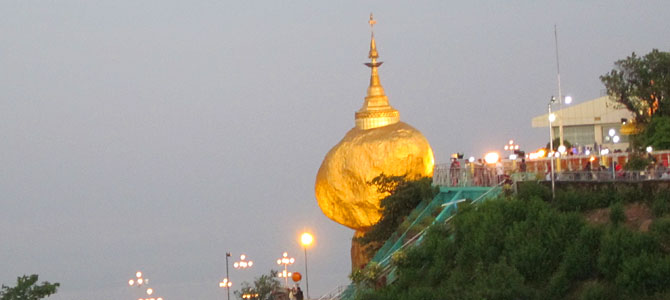
The Golden Rock (Kyaik-htiyo or Kyaiktiyo) is a sacred, massive gold –leafed boulder delicately balanced on the edge of a cliff and is topped by a small stupa at the top of Mount Kyaik-hti-yo. It was built in the year 574 BC more than 2500 years ago and now well know as Miracle Golden Rock and which starting at pilgrim-village. An endless stream of pilgrims comes to admire the sight and add squares of gold leaf to its surface. The Golden Rock is a truly extraordinary natural feature. It is little wonder it is regarded with such sacred awe. According to legend, it is kept in place by a single hair of the Buddha. The views from the Golden Rock are spectacular and many visitors stay to watch the sunset.
Mawlamyine
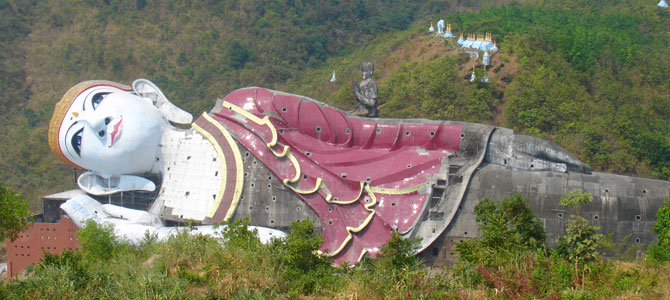
Mawlamyine is the capital of Mon state and third largest city of Myanmar which also known as Moulmein. Situated 300 km south east of Yangon and 70 km south of Thaton, at the mouth of Thanlwin (Salween) river. Mawlamyine experiences a tropical climate with a lower humidity than in most parts of South East Asia. Its temperature averages between 25.6o C during January, its coolest month to 29.4o C in April, its hottest month. The rainy season is between June and October although the greatest rainfalls usually occur in July and August. The average annual rainfall in Mawlamyine is 190 inches. The population of Mon State is 3 million and consists mainly of Mon and Myanmar. It has a main railway station which communicates with the Burmese capital in the north and Southern. The old Death railway is also a diverted route from Mawlamyine at the town of Thanbyuzayat.
The Glass Palace by Amitav Ghosh. A novel that spans a century, from British conquest to the modern day. A compelling account of how a family adapted to the changing times; provides much insight into Burmese culture.
Hpa-an
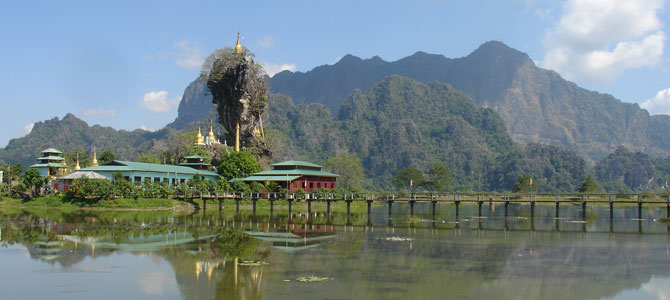
Hpa-an is the capital of Kayin State. Recently removed from the restricted list of travel destinations. Possible to reach it by road from Yangon across a new Bridge (Thanlwin) over the Thanlwin River. Hpa-an is small town but busy commerce center you can see farmer coming to town in horse carts or trishaws stacked with baskets to sell in the market. The population is about 50,000 people are most of are Kayin. The tourist interested places are Bayin Nyi Naung Cave and Mt. Zawekabin.
Hotels In Myanmar
- Hotels In Yangon
- Hotels In Mandalay
- Hotels In Bagan
- Hotel In Inle
- Hotel In Others
Multi-Country Tours
- Myanmar - Cambodia
- Myanmar - Vietnam
- Myanmar - Laos
- Myanmar - Thailand
Travel Tips
- About Myanmar
- Myanmar Festival
- Public Holidays
- Travel Tips Embassy
Transportation
- Airlines Information
- River Cruise In Myanmar
- Myanmar Car Rental Service
- Train Schedule